
Hey friend,
Pull up a chair.
Welcome back to Saturday's Table. If this is your first time here this year, I'm glad you're here.
Let's talk about something most people don't prepare for until it's too late.
Layoffs.
Not the headlines. Not the LinkedIn sympathy posts.
The actual reality of what happens when the tap on the shoulder comes and you realize you've built your entire identity inside corporate walls.
In Q4 2025 alone, tech, finance, and media eliminated over 140,000 roles. But here's what doesn't make the news:
78% of laid-off professionals say the hardest part wasn't financial.
It was answering two questions: "Who am I without this job?" and "What comes next?"
The professionals who rebound fastest?
They weren't just financially prepared. They were strategically positioned before the layoff ever happened.
Let's be real about what that actually means.
The problem nobody's preparing for
Most people think layoff preparation looks like this:
→ Update your resume
→ Polish your LinkedIn profile
→ Set up job alerts
→ Start networking when you hear rumors
→ Save a little extra money just in case
And when the layoff comes? They're scrambling.
- Scrambling to remember what they accomplished.
- Scrambling to figure out what they're actually good at outside of their job title.
- Scrambling to explain why they're suddenly available when three months ago they were crushing quarterly goals.
Here's what I've learned supporting senior leaders through involuntary transitions:
The professionals who struggled most weren't the ones with smaller savings. They were the ones who built their entire identity inside corporate walls.
Their network? Internal only.
Their proof of value? Trapped in systems they no longer had access to.
Their positioning? Entirely dependent on a title that disappeared overnight.
Am I tripping, or does that sound like most of us?
How most people solve it (and why it backfires)
When people think about "being prepared," they default to these approaches:
The Resume Refresh Approach
Keep your resume updated. Polish it quarterly. Make sure it's ATS-friendly.
The Emergency Fund Approach
Save 3-6 months of expenses. Cut back on spending. Build a safety net.
The LinkedIn Optimization Approach
Keep your profile current. Post occasionally. Make sure recruiters can find you.
The Internal Network Approach
Build strong relationships at work. Be visible to leadership. Stay connected to your team.
The "Just Work Harder" Approach
If you're valuable enough, they won't lay you off. Outperform everyone. Make yourself indispensable.
Y'all with me so far?
Here's why none of these actually protect you:
Resumes are reactive. By the time you're updating yours, you're already behind thousands of other people doing the same thing. You're competing in the pile, not positioned above it.
Emergency funds buy time, not clarity. You can have 12 months saved and still have no idea who you are without your title or what you're actually selling.
LinkedIn profiles are passive. Unless you've been building authority and positioning value externally, your profile is just a prettier version of your resume.
Internal networks freeze during layoffs. The people you built relationships with are either laid off themselves, worried about their own jobs, or unable to help you because they're trying to survive the restructure.
"Indispensable" is a myth. I've worked with top 1% performers at Fortune 50 companies who got cut.
Being good at your job doesn't make you layoff-proof. It just makes the surprise hurt more.
The real issue?
All of these approaches treat layoffs as something that happens to you instead of something you prepare for strategically.
🔑The Shift: From exit-desperate to exit-ready
Here's the clarity key that changes everything:
Exit-ready professionals don't get lucky. They get prepared.
Not by living in fear.
Not by job-hopping out of paranoia.
Not by sacrificing current performance or pretending loyalty doesn't matter.
They prepare by building leverage while they're still employed.
By documenting wins in real time. By maintaining relationships outside their organization. By knowing their financial reality. By positioning themselves as ready, not desperate.
This is what I call The Exit-Ready Framework—six things you build continuously, not just when layoff rumors start circulating. Here’s what exit-ready actually looks like in practice
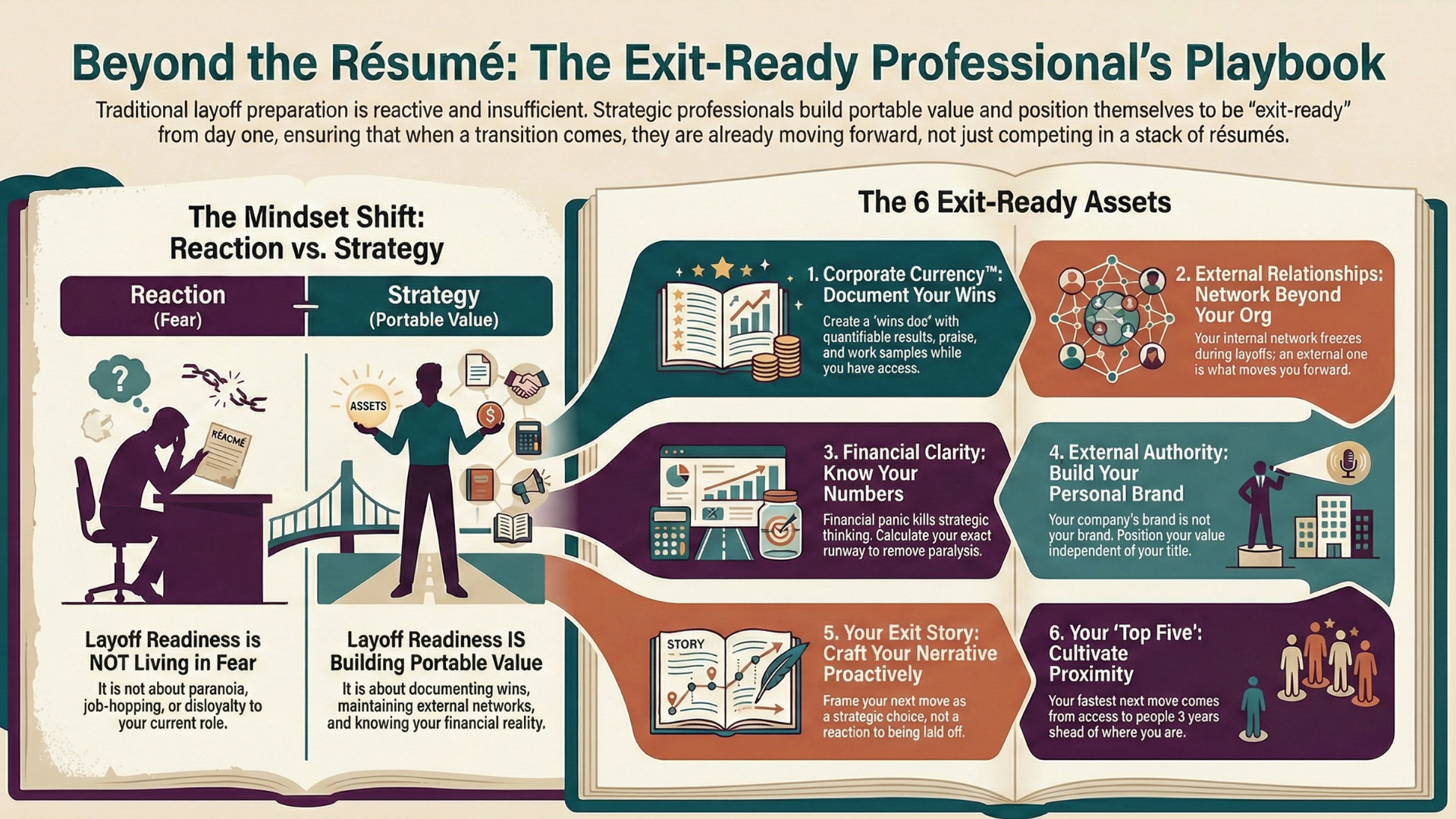
The Exit-Ready Framework
1. Corporate Currency™ (Monthly)
This is your documented proof of value. Not what you remember doing. What you can prove you did.
→ Create a "Wins Doc" with quantifiable results (revenue driven, problems solved, projects led)
→ Screenshot key emails with praise or recognition
→ Save work samples while you still have access (presentations, reports, strategies)
→ Document who you worked with and what you accomplished together
Why it matters: Corporate memory is short. Your documented wins are portable proof of value that travels with you regardless of who signs the paycheck.
2. External Relationships (Quarterly)
Your future network cannot live only inside your current employer.
→ Reconnect with 5 former colleagues (alumni relationships are gold)
→ Join 1 industry community or professional group
→ Attend 1 conference or virtual event outside your company
→ Schedule 1 coffee chat with someone doing work you admire
Why it matters: When layoffs hit, your internal network often freezes. Your external network is what saves you.
3. Financial Clarity (Always)
Peace comes from numbers, not guesses.
→ Calculate your monthly burn rate (what you need vs. what you spend)
→ Know your savings coverage (how many months can you survive?)
→ Identify what expenses could be cut immediately if needed
→ Have your "if-then" plan ready ("If laid off, then I'll...")
Why it matters: Financial panic clouds strategic thinking. Clarity removes paralysis.
4. External Authority (Ongoing)
Your title is temporary. Your value shouldn't be.
→ Update LinkedIn with quantifiable results (not just responsibilities)
→ Write 1 post per month sharing an insight from your work (without proprietary info)
→ Comment on 3 posts in your industry (be visible)
→ Make sure your headline reflects your value, not just your title
Why it matters: Your company's brand is not your brand. Build yours while you're still employed.
5. Your Exit Story (Before You Need It)
Control the narrative before circumstances do.
Answer these 3 questions now:
→ What am I great at? (expertise that's portable)
→ What problems do I solve? (value I create)
→ Where am I headed? (clear direction, even if the path isn't set)
Why it matters: "I was laid off" sounds reactive. "I was already positioning for this transition" sounds strategic.
6. Your Top 5 (Proximity Strategy)
Access accelerates transitions.
→ Identify 5 people doing work you want to be doing in 3 years
→ Follow their content, study their path, engage authentically
→ When appropriate, reach out with genuine questions (not asks)
→ Stay visible in their ecosystem
Why it matters: Your fastest next move comes from proximity to the right people, not from application portals.
Notice what's not on this list
Your resume.
Not because resumes don't matter. They do.
But because by the time you're updating your resume, you're already reacting.
Strategic professionals build leverage before they need to position it on a single page.
Your resume documents what you've done. These 6 things determine where you go next.
When the layoff tide hits,
The professionals with updated resumes are competing with thousands of other professionals with updated resumes.
The professionals with Corporate Currency™, external relationships, financial clarity, positioned authority, strategic narratives, and proximity to the right people?
They're not competing. They're already moving.
This week, pick one
You don't have to do all six this week. You don't even have to do all six this month.
But you do need to start.
Pick one:
→ Start your Wins Doc (30 minutes to set it up, 10 minutes monthly to update)
→ Reach out to 2 people outside your org (just to reconnect, no ask)
→ Calculate your actual monthly burn rate (you need to know this number)
→ Post one insight from your work on LinkedIn (share what you're learning)
→ Write down your exit story (answer those 3 questions honestly)
→ Identify your Top 5 (who's 5 years ahead of where you want to be?)
Start with one. Build it this week.
Because layoffs are increasingly common. And rarely planned for.
The only real question is whether you'll meet that transition exit-ready or exit-desperate.
📖 The Beautiful Exit™ Workbook includes the complete Corporate Currency™ Audit Template, the Exit-Ready Checklist with timelines, and real stories from professionals who positioned through layoffs strategically.
Week 2: Corporate Currency—what translates and how to document it
Week 3: Power—turning adversity into advantage
Week 4: Designing your strategic exit (relationships, reputation, runway)
👉 Order The Beautiful Exit™ Workbook
Build your leverage before you need it.
Document your wins before they're forgotten.
Position your value before someone else defines it for you.
Your resume can wait.
Your positioning can't.
Make your next move your best move.
See you next Saturday,
Jraya
P.S. Which of the six are you starting with this week? Hit reply and let me know. I read every response.